Recycling
You can place mixed recyclable items in yellow recycling bins around campus. Find out which items can be recycled, and which items must be left out.
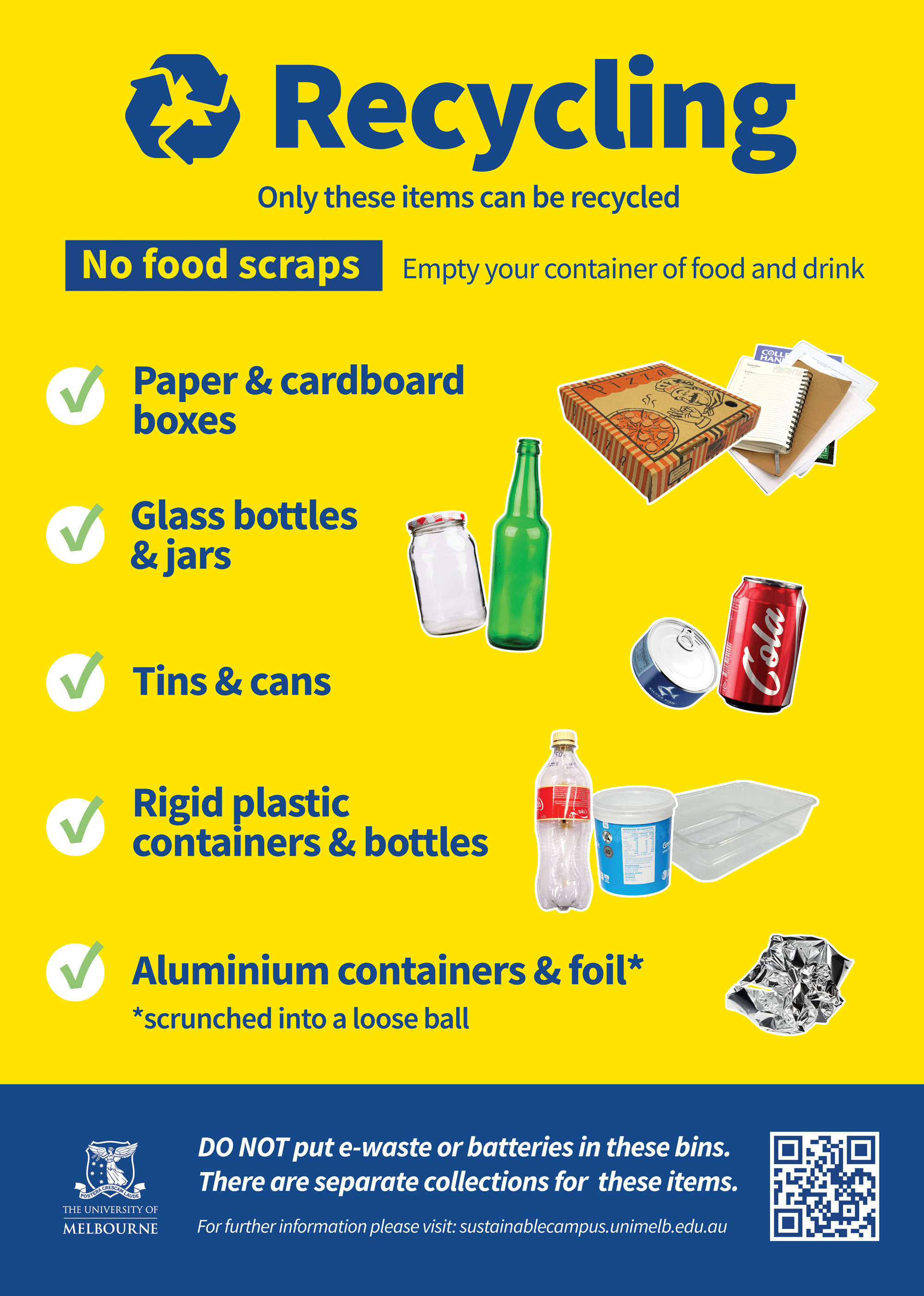
What to put in
- Paper and cardboard (large cardboard boxes can be disposed of in skips around the university)
- Cardboard and paper containers
- Glass bottles and jars
- Tins and cans (do not crush cans before placing in the recycling)
- Hard plastic containers and bottles
- Aluminium containers and foil (must be scrunched into a loose ball no smaller than the size of a tennis ball)
- No food scraps
Items must be emptied and cleaned of food residue before going into the recycling.
What to leave out
All items put into the recycling must be free of food waste. It is not necessary to clean your container thoroughly, but there should be little to no solids or obvious food residue before any item goes in the recycling.
- Disposable coffee cups
Disposable coffee cups are not recyclable on campus as they contain a plastic inner layer which is too difficult to separate from the paper cup during the recycling process. - Soft plastics
Any plastic that can be scrunched and not return to its original shape should be put into the landfill bin. Due to the flat, thin nature of soft plastics, in a recycling facility they often end up being sorted with the paper, causing contamination in the recycling process. - Paper towel, tissues and serviettes
These materials don’t recycle well due to additives. - Cutlery, chopsticks and straws, both bamboo and plastic
These items are too small to be processed and wood and bamboo are not collected in yellow bin recycling systems. - Bioplastics
Bioplastics only biodegrade in specific conditions and cannot be recycled.
If there are too many non-recyclable items in the recycling, it will be difficult to sort items once they reach a facility. This reduces the amount of material that is able to be recycled.
To avoid contamination and ensure that your recycling efforts don’t go to waste, check the signs before putting your rubbish in the bin. If in doubt, leave it out of the recycling!
Where do we send our recycling?
The contents of the university’s recycling bins are currently sent to a Materials Recovery Facility (MRF) to be sorted into different streams and sent for recycling.
Bin liners at the University
Clear bin liners line the university's recycling bins. This does not mean the recycling is sent to landfill. This is to distinguish the recycling from the black liners that carry waste going to landfill.
Student Precinct Circular Station trial
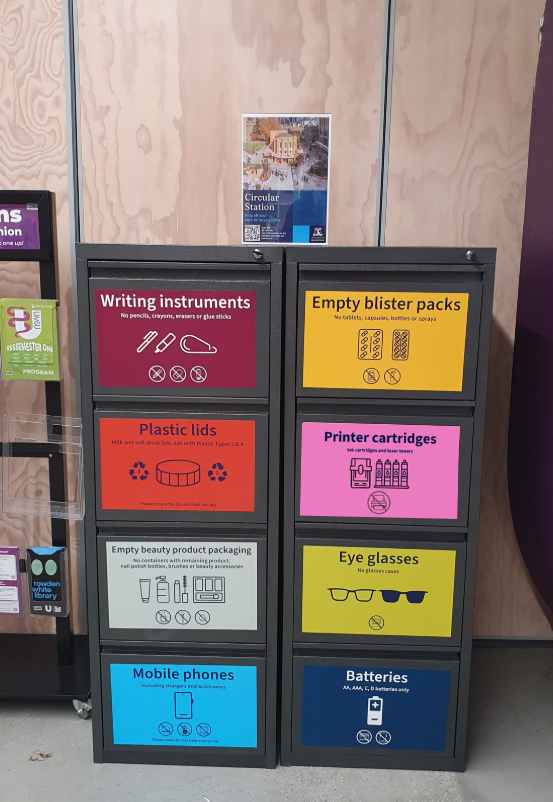
Student Precinct Circular station
The circular station is located between the UMSU Information Desk and the Ida Bar on Level 1 of Building 168 on the Parkville campus and collects hard-to-recycle waste streams. The initiative simultaneously encourages consideration of the true value of "waste" and capacitates the University community to divert further "waste" from landfill.
-
Accepted: Lithium and alkaline batteries
Not accepted: Lead acid batteries
Recycled through: Campus Assist battery recycling.
-
Accepted: Any brand of cosmetic, hair care, skincare packaging and perfume bottles.
Not accepted: Packaging still containing lots of product, wooden makeup pencils, makeup wipes or cloth face masks, nail polish bottles and nail polish remover bottles, bags, brushes, makeup sponges, false eyelashes, eyelash curlers and other beauty accessories.
Recycled through: MECCA Beauty Product Recycling Program Terracycle
-
Accepted: Empty blister packs.
Not accepted: Pill bottles and spray bottles.
Recycled through: Pharmacycle
-
Accepted: Eyeglasses
Not accepted: Glasses cases
Recycled through: Specsavers glasses recycling program
-
Accepted: All brands of mobile phones, their chargers and accessories.
Not accepted: Loose mobile phone batteries, iPads and tablets, computers, laptops and TVs.
Recycled through: Mobile Muster
Please erase all data from your mobile phone. We cannot guarantee the security of any personal data that remains on donated phones.
University of Melbourne staff phones must NOT be donated here. These need to be securely donated by submitting a ServiceNow e-waste request for data privacy.
-
Accepted: Plastic lids (Recycling number 2 and 4)
Not accepted: Other plastic types, plastic bottles
Recycled through: Lids4Kids and the Precious Plastics Program
-
-
Accepted: Pens, highlighters, corrective tape and white out, markers, highlighters and pen soft plastic packaging.
Not accepted: Glue sticks, Erasers, Rulers, Pencils, Crayons and Sharp objects.
Recycled through: BIC x Terracycle and Officeworks
Explore more in recycling
-
Paper and cardboard
Find out how to reuse and recycle books, paper or cardboard around the University
-
Better coffee
What is your cup of coffee decision costing the environment? Here's a few ways you can enjoy coffee sustainably.
-
Aluminium cans and foil
Recycling aluminium isn't as straight-forward as just popping it into the recycling.