Preferred suppliers and tips
The University has a panel of preferred suppliers for the research. The Procurement Services team actively manages relationships with preferred suppliers to deliver sustainable procurement options that align with the University's environmental commitments.
When you choose our preferred suppliers, you gain access to:
- Prioritise suppliers with packaging removal and recycling initiatives that minimise waste and reduced carbon footprint through optimised logistics and delivery routes.
- Products meeting higher environmental standards and certifications.
- Suppliers initiated trade-in program options for your second-hand or obsolete equipment.
- Prioritise energy-efficient products that reduce overall University energy and water consumption.
- Purchase for quality and long-term durability products.
- Target suppliers with transparent supply chains with ethical sourcing practices.
- Support for suppliers investing in green initiatives, renewable energy and carbon offset programs.
Researchers and purchasers are encouraged to engage with suppliers on these panels to help advance the University’s broader sustainability goals.
Sustainable lab purchasing
When procuring laboratory and scientific equipment, consider the asset lifecycle model:
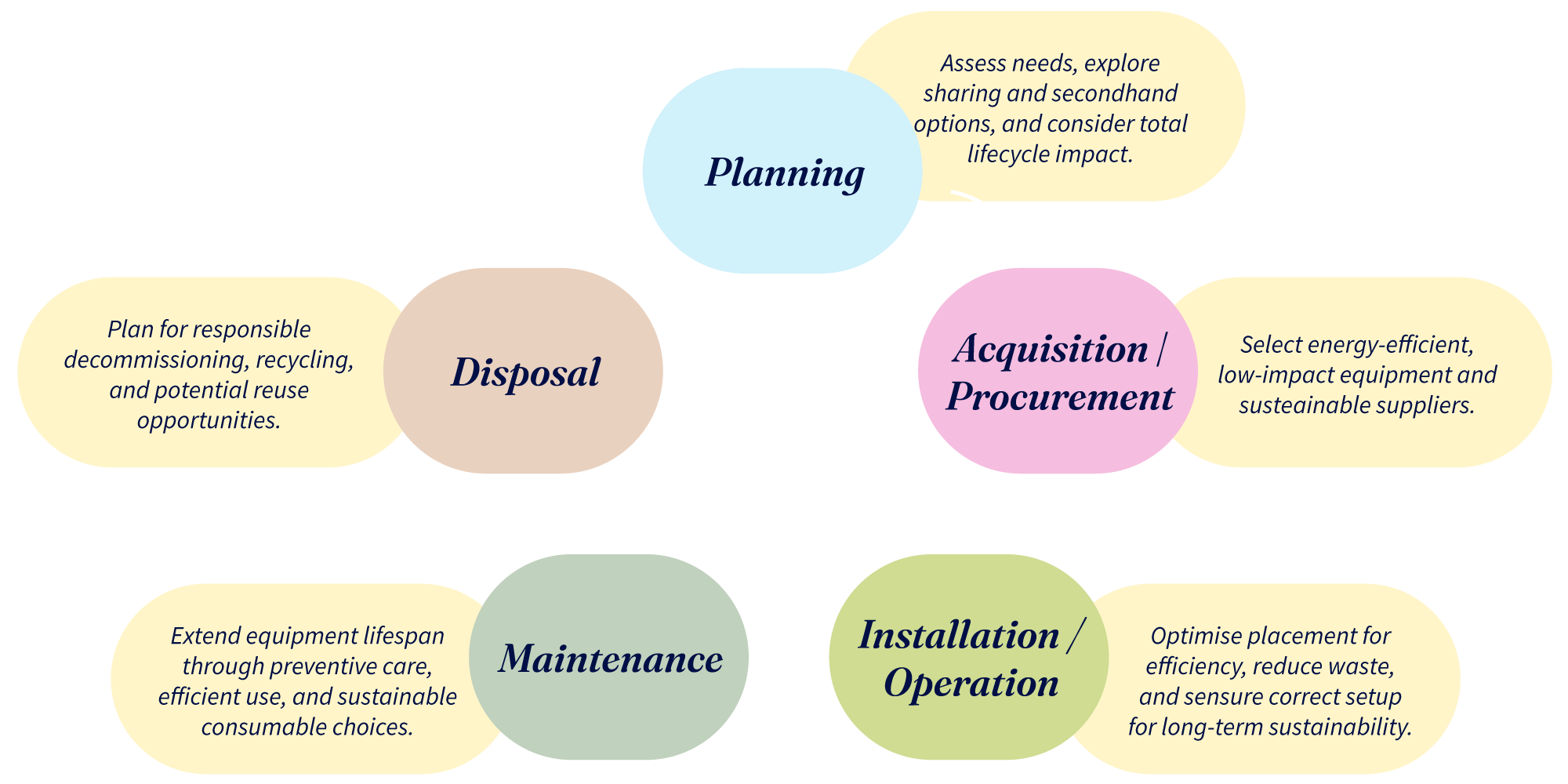
When planning the procurement
Before purchasing new equipment, consider the principles of reduce, reuse, recycle to guide more sustainable decision-making.
-
- Assess actual need: Check if existing University equipment can be shared, upgraded, repaired or reused before purchasing.
- Review inventory: Avoid duplicate purchases by checking your inventory.
- Plan bulk purchases: Consolidate orders to reduce packaging waste and shipping emissions. But also, be mindful of buying more than you need, avoiding buying bulk volumes of products with a short shelf life if you don’t require bulk quantities. Use the University’s specialist stores network or centralised purchasing if your faculty offers it.
-
- The University sharing: Join our Zero Waste community to find out if colleagues have equipment they no longer need, or to repurpose items you're no longer using.
- Second-hand or refurbished options: Investigate whether other organisations like other universities, research institutions, hospitals, CAE Online have similar units for sale. Note: Consider the risks of purchasing used equipment, such as unit age, technology, warranty, transfer of ownership, and availability of support.
-
- Retire units that are past their effective life: new-generation lab equipment often has much higher energy efficiency. Please contact the Sustainability Delivery team to learn more about available funding options or review the Sustainability Innovation Accelerator Program (SIAP) guidelines (PDF 348.8 KB) to apply for specific funding.
- Assess total cost of ownership (TCO): Consider energy use, maintenance costs, and disposal fees before purchasing.
- Consider recycling or reusing options in your laboratory process: Prefer equipment with components that are easy to recycle at the end of its life or simply reuse. For example, reusing pipette racks or using washable glassware.
- Plan for take-back programs: Check if the supplier offers recycling or trade-in options.
When procuring
Once the need for new procurement is identified, there are a few considerations to assist you in making a sustainability-conscious choice.
-
- Recycled materials and packaging, for example, bio-based consumables
- Eco-intelligent design, for example, temperature stable reagents
- Minimise chemical impact, choose models compatible with Green Chemistry practices.
- Reduce hazardous waste, opt for equipment that generates less chemical waste during operation.
-
A) Use University catalogues:
The University’s purchasing platform, eMarket, features a social and sustainable tagging system to assist in selecting environmentally friendly equipment.
B) Look out for third party accreditation Labels (Eco-Labels) – My Green Lab® ACT® Ecolabel for Laboratory goods.
There are multiple global organisations that provided sustainability certification: Alliance for Water Stewardship, EU Ecolabel, Ecovadis, Cradle-to-cradle, B Corporation, and many others. Whilst they can help you with your purchasing decision, we recommend My Green Lab® ACT® Ecolabel, a laboratory-specific sustainability framework.
Learn more about sustainability certification and ecolabels

My Green Lab® ACT® Ecolabel
My Green Lab® ACT® Ecolabel is a certification for laboratory products that provides third-party verification of their environmental impact. It's essentially a "nutrition label" for lab products, helping scientists and procurement specialists make more sustainable purchasing choices. Ecolabel is a scorecard that considers multiple factors such as audit of the product (materials, energy and water consumption, chemicals used, lifetime), audit of the packaging, manufacturing facility, Company Green House Gas (GHG) Reductions, carbon reporting, improvements, and innovation.
The ACT database is a global database for laboratory products with ACT Ecolabels and can assist in assessing the Environmental Impact Factor.
There are two types of ACT® Ecolabels:
1.0 – Original Ecolabel: Uses an Environmental Impact Factor score—the lower the score, the better the choice. This version is gradually being phased out.
2.0 – Updated Ecolabel: Features a simplified rating system—Gold, Silver, or Bronze, with Gold representing the most sustainable choice.
The ACT® Ecolabel contains information on various environmental impact factors and includes a selection of equipment from multiple manufacturers, including Thermo Fisher Scientific, Waters, Agilent, Eppendorf, Qiagen, and others.
Access the My Green Lab website to review the different Ecolabels
C) Assess supplier sustainability commitments:
Choose vendors with recycling programs, carbon reduction targets, and eco-friendly logistics.
-
- Minimise Non-Recyclable Packaging: enquire from your potential suppliers on their packaging its recyclable alternative (e.g., wool based alternative to polystyrene).
- Where practical, select local suppliers: minimise carbon footprint through shorter supply chains. Some basic lab equipment like autoclaves and freezers are manufactured in Australia.
- Where practical, select sea freight option: when timing is not a consideration, choose sea freight as opposed to air, as it is considered more sustainable and oftentimes, much cheaper.
-
- Prioritise energy-efficient models:
- Energy Star-rated lab equipment (Database).
- ACT Label-certified products (Act - ACT Database).
- Choose low-water-use equipment:
- Use Water rating label.
- ACT Label-certified products (Act - ACT Database).
- Prefer models with recirculating water systems instead of single-pass cooling.
- Prioritise energy-efficient models:
-
- Select non-toxic reagents: Where possible, use safer alternatives with reduced environmental impact.
- Reduce single-use plastics: Prefer reusable consumables or items made from biodegradable materials.
- Check solvent use: Choose equipment that works with low-hazard, low-waste chemicals.
Procurement sourcing process
The University has established procurement processes that incorporate sustainability considerations at every stage. These processes (refer to the generic workflow chart) ensure compliance with regulatory requirements while advancing our sustainability objectives. The specific procurement pathway depends on the cost of the goods or services being acquired.
Details on changes are available on the Procurement Sourcing Processes KBA page.

When operating
Once your equipment has landed in your lab, follow the Sustainable Labs Best Practices
During maintenance
Regular maintenance assists in sustainability efforts by extending the useful life of your equipment and ensuring low water and electricity consumption.
-
- Follow preventive maintenance schedules: regular servicing prevents breakdowns.
- Calibrate equipment regularly: reduces energy waste and inaccurate results.
- Train staff on best practices prevents improper use that can lead to excess wear and tear. Find out more information in Sustainable Lab Best Practices.
-
- Reuse and refill consumables: Where possible, avoid single-use items.
- Choose Green Chemistry-compatible supplies
- Please review the Lab Best Practices section to explore our recommendations for managing energy, water, and waste.
When disposing
When the equipment has reached the end of life, consider these sustainable options.
-
- Donate or repurpose equipment: Some organisations accept functional lab equipment for reuse in education and research.
- Phoenix Schools Programme in Australia: encourage and inspire the next generation of STEM students.
- Equipsent: enable education everywhere.
- Seedling Lab: based overseas, but it is a valuable reference for responsible lab equipment decommissioning practices.
- Return to manufacturers: check for trade-in or recycling programs.
- Find a buyer (via the professional circles, companies like CAE online).
- Donate or repurpose equipment: Some organisations accept functional lab equipment for reuse in education and research.
-
- Understand their process: work with the supplier/manufacturer to understand the disposal process to ensure is sustainable.
- Sort hazardous waste properly: Use University-approved waste streams for chemicals and lab plastics.

Do you have an idea to improve the sustainability of your lab?
Please contact sustainable-campus@unimelb.edu.au to share lab sustainability ideas relevant to your discipline.